What Owning a Dog May Teach Us About Service Management
Why choosing and managing service management frameworks is less like picking a “winner” and more like choosing the right breed
March 13, 2026
Richard Petti
What Owning a Dog May Teach Us About Service Management
INTRODUCTION

We are all passionate when it comes to the types of house pets we may choose to own. Emotions run high when you decide to select one to add to the family, takes time out of every family life to take care of it, and then we become emotional again when the time arrives to say goodbye.
Seems that IT practitioners are similarly passionate about best practices they choose to use to perform the work of IT Service Management. A working definition of ITSM for purposes of this discussion is:
ITSM is managing IT as a business in support of the business, using a collection of best-practices and standards to manage a portfolio of IT products and services that add value to business’ products and services.
As technology evolves, there is a shift happening from ITSM to the concept of Digital Product & Service Management (DPSM): per ITIL®:
DPSM is “A set of specialized organizational capabilities for enabling value for customers in the form of digital products and services.”
My wife and I love dogs. We grew up with them since we were kids. We have had our fair share of joy adopting and caring for them and heartbreak when that day arrived to part each other was present.
Our own family’s first dog was a Golden Retriever; she was with us 17 years.
A few years later we acquired a Newfoundland, then years later our last family pet member was a Bernese Mountain dog.
As a result of our love of dogs, we watch dog shows that have different groups of dogs with breeds in them. Each breed in a group exists for a specific purpose. A dog may have been bred to guard, guide, hug, hunt, herd, haul, hound, retrieve, or a combination of those characteristics; and each dog in a breed has a corresponding personality and temperament, even if it is from the same litter.

One breed may be more suitable for one type of home, better with children or seniors, serves as a companion, complements our lifestyle, or we just like its ‘look’. They need to fit in with the family and we all need to adjust to living together. Over time our adorable puppy grows and needs our daily care and love as all members in the family do.
In business, a best practice, standard or a combination of them for one organization may be unsuitable for another.
‘That dog won’t/don’t hunt.’

Would you ever tell another dog owner that your dog is better than theirs or that their dog is the wrong choice for them? Like you have, each owner has their individual set of criteria, conditions, and considerations that influenced their choice of dog.
As seen in social media, sometimes, multiple times daily; there have been many blogs, posts, and comments complimenting or critiquing IT best practices, and understandably, there is less such commentary on standards.
Folks present their favorite framework that often includes stating why theirs is better than another, even though by design they are simultaneously prescriptive for new users and non-prescriptive as organizations evolve when using them. There seems to be much less disagreement on related standards, because they often are more prescriptive in nature and perhaps driven by governance.
Often in best practice discussions, the choice is presented to be binary, choose one or the other.
When I first got into the conversation about IT best practices in May 2005, I joined it with 35 years combined IT experience in the military and in a computer manufacturer’s organization. The arm wrestling then was between ITIL and COBIT. A best practice with a non-prescriptive characteristic is often contrary thinking for IT staff, whose success depends on a prescriptive, binary mindset.
Sometimes there is strong disagreement on which best practice to use, e.g. Agile vs. DevOps, ITIL vs. IT4IT, USM vs. ISM, and PRINCE2 vs. PMBOK. The debate often causes friction between internal IT functions, such as engineering and operations. Do you think our customers really care which best practice or version of it IT uses?
A best practice is too often and easily blamed as the root cause of IT’s failure to meet business, customer, and user expectations. But the core reasons this happens are many and not the fault of a non-prescriptive best practice itself. More often, it is how the guidance was selected, how it was interpreted, and how well it was resourced, and how well it was Adapted to enable specific business needs.
Companies that are successful using public frameworks, that may have started as experimental, operational, or grassroots efforts; Adopt best practices strategically, then provide the resources needed to perform the work of creating, maintaining, and improving their own value streams, before or in concert with the automation of same. Ideally, they optimize then automate.

The work of selecting one or more best practices to perform the work of IT Service Management, is like choosing, owning, and caring of a pet in your family.
As it is with our family‘s pets, best practices require thoughtful selection, care, and feeding to fit into the corporate family.
For a business, there are two pairs of archetype characteristics for selection of best practices that need to be in concert with each other: the purpose and capability of the practice is compatible with the purpose and culture of the business, and then maintained to sustain success.
Due to the increased complexity of technical components, systems, and correspondingly IT solutions, as well, the desire to digitize services; no single IT or non-IT best practice (nor one standard ) will do it all. Organizations will need to consider a hybrid mix of practices and standards, from many frameworks, that will best enable their workflows and value streams.
Consider Best-practices and Standards as other forms of 'technology' per a definition shown here:
“Technology is the application of scientific knowledge for practical purposes, encompassing both tangible tools (machines, hardware) and intangible systems (software, methods). It drives innovation across industries, improving efficiency, connectivity, and quality of life.”
Therefore, from a technological point-of-view, like managing IT solutions; managing best practices and standards require strategy, design, acquisition, build, transition, operation, support, deliver, and continual improvement effort.
Businesses will usually require a portfolio of best practices and standards to support value streams.
To illustrate:, an example for one organization may require:
o COBIT and ISO::38500 for governance
o TOGAF for architecture
o ITIL Asset plus ITAM (with HAM & SAM)
o RiskIT and ISO::31000 for risk management
o IT4IT and ISO::20000 for ITSM/DPSM
o PRINCE2 or PMBOK for projects
o ISO::27001, GDPR, & HIPPA for security
o Industry 4.0 and ISO::9001 for manufacturing
o SAFe and DevOps for engineering
o ITIL and LEAN for continual improvement
o Standards such as ISO::9001 for business in the EU and member countries within
o Adoption of or compatibility with other stakeholder’s governance, best practices, & standards requirements
From the above list, IT could be using up to fourteen practices (14) and five standards (5) that would be listed in an IT Best Practices & Standards Portfolio in the figure below.

AN ALTERNATIVE APPROACH TO PERFORM ITSM / DPSM
A way to manage best practices and standards strategically is through Portfolio Management, then tactically and operationally with the Service Catalog, a Service Request Catalog, and Service Level Agreements. An integrated Portfolio approach is a more mature way to manage the use of all best practices and standards.
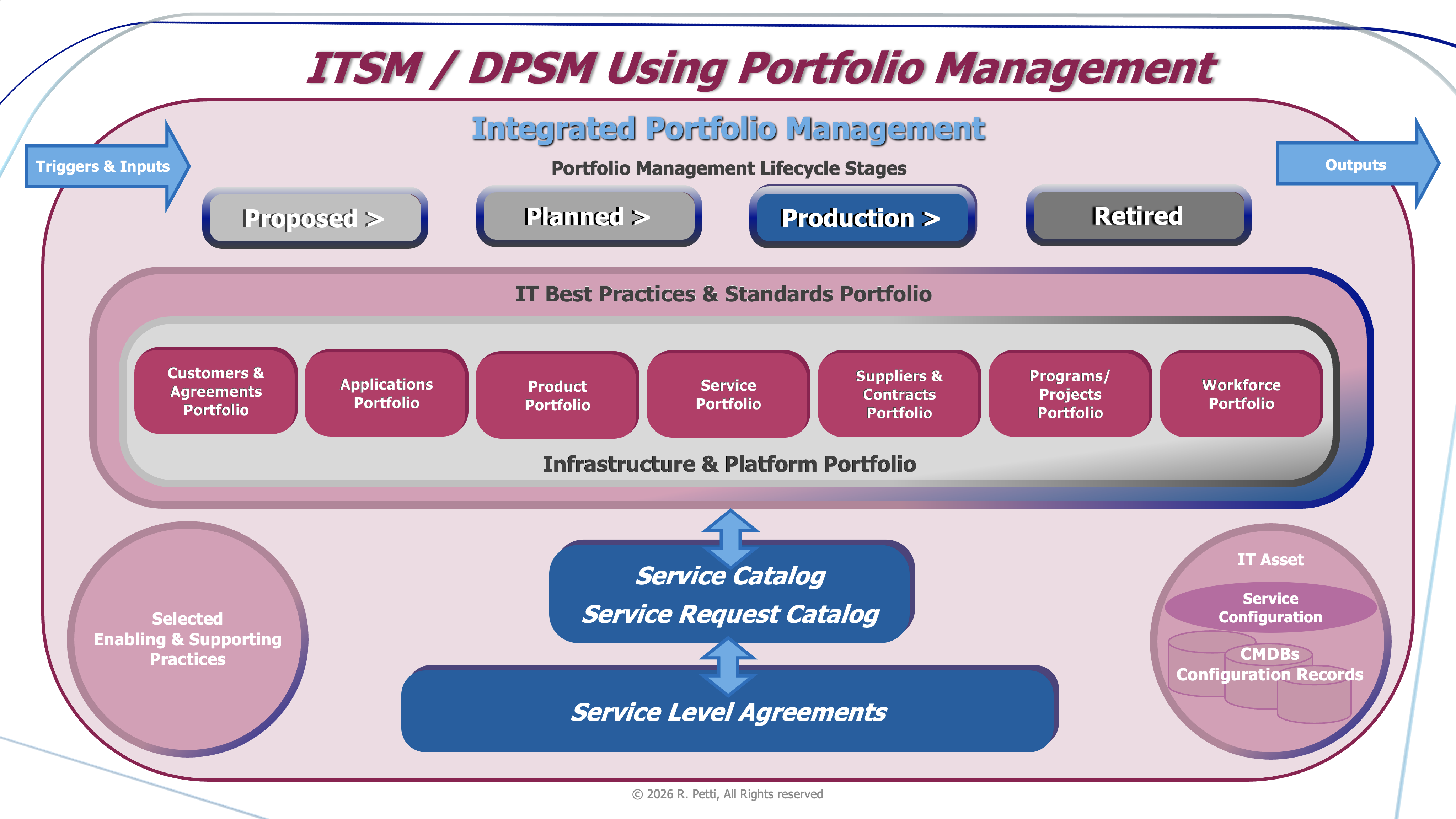
“The purpose of the Portfolio Management practice is to ensure that the organization has the right mix of programs, projects, products, and services to execute the organization’s strategy within its funding and resource constraints.”
A formal definition of a portfolio may be useful: “a collection of investments that are owned by a particular person or organization.” They all require care and supervision to remain in mint condition to maximize their value to the owner.
There are seven archetype IT portfolios in the figure above, plus the IT Practices & Standards and the IT Infrastructure and Platform Portfolios.
The Infrastructure & Platform Portfolio would include the hardware, software, networks, and facilities that are required to manage IT products and services.
Depending on what they are, assets in portfolios are logged, documented, secured, and managed during their lifecycle as records; in boxes, cabinets, closets, crates, folders, files, lockers, safes, databases, warehouses, or other such ‘systems’.
Using ITIL as a reference, a portfolio management practice may have four lifecycle stages in which to review assets, no less frequently than quarterly or ad hoc as external or internal forces require:
Ø What is being proposed or pending review
Ø What is approved, scheduled, and progressing to be in a Portfolio
Ø What is currently in production (operation) and when does it need to be reviewed for action
Ø What needs to be considered for retirement and has been retired
Classic portfolio decisions that may be made are:
o Approval of business plans & charter implementation to enhance or improve existing portfolios/assets
o Retain current assets in a portfolio that meet their current purpose & value
o Rationalize assets by reducing duplicity
o Refactor assets by reducing complexity
o Reprioritize assets to better match business value
o Renew, Refresh, or Replace assets to maintain value
o Repurpose assets to a new role
o Retire and dispose of assets
Key inputs to the Portfolio practice are:
- Organizational strategy resources, funding, and budget
- Analysis of the organization’s key resources
- Analysis of stakeholders and their requirements
- Assessment of the organization’s market position & benchmarking
- Service and product information
- Services and markets risk assessment
- Portfolio management approach, guidelines, & capability
- The organization’s portfolios and initiatives
- Feedback, reports, and suggestions from stakeholders and portfolio reviews
- Value and performance data
Related IT Practices to consider using integrated Portfolio management for ITSM/DPSM are:
o Strategy
o Asset Management
o Business analysis
o Project Management
o Relationship Management
o Service Financial Management
o Continual Improvement
o Architecture
o Infrastructure & Platform
o Service Configuration
o Service Design
o Service Level Management
o Service Catalog
o Service Request
o Supplier Management
o Change Enablement

SUMMARY
It takes a unique combination of Best Practices and Standards for any organization to perform ITSM/DPSM for the life of their business.
Think holistically & systemically that Practices and Standards are strategically selected technologies used to manage technology!
They are valuable assets that may need to be managed as configuration items for their lifecycle.
Apply the same due diligence and discipline that is used to select, procure, and manage internal technology, suppliers, products, and services; to choose, implement, and maintain a hybrid mix of best practices and standards.
Each business needs to strategically manage an integrated Portfolio of their preferred collection of IT & non-IT best practices and standards in support of their preferred, proprietary, and unique workflows and value streams to meet the demands on today's businesses supported by IT.
Choose, manage, and improve the capability of your best practices and standards that best fits the business based on customer requirements that adds value for IT, your internal customers, and your customers’, customers.
Then manage those selected IT and non-IT practices and standards, strategically thru integrated Portfolio Management to fulfill the intended purposes that maximizes value for the business.
Those dogs will then be able to best serve the planned purpose.
Sign in or Join the community
Where conversation, connection, and real-world practices come together.

Create an account
Where conversation, connection, and real-world practices come together.
5
Comments (0)
Popular

Popular
Dive in
Related
Blog
Reframing ITIL: From Service Management to Value Management
By Mike Alstrom • Nov 3rd, 2025 • Views 149
Blog
The New ITIL (Version 5): Value Streams Deliver Flow, Experience Delivers Value
By Scott Everett • Mar 16th, 2026 • Views 56
Blog
The AI-Native Enterprise: Navigating AI Integration and Governance in ITIL (Version 5)
By Ramesh M • Mar 26th, 2026 • Views 63
Blog
Reframing ITIL: From Service Management to Value Management
By Mike Alstrom • Nov 3rd, 2025 • Views 149
Blog
The AI-Native Enterprise: Navigating AI Integration and Governance in ITIL (Version 5)
By Ramesh M • Mar 26th, 2026 • Views 63
Blog
The New ITIL (Version 5): Value Streams Deliver Flow, Experience Delivers Value
By Scott Everett • Mar 16th, 2026 • Views 56