Leadership
November 3, 2025
Reframing ITIL: From Service Management to Value Management
# ITIL
Reconnecting Organizational and Technology Leadership Through a Shared Language of Value

Mike Alstrom
Reframing ITIL: From Service Management to Value Management
Why do executives and technology leaders continue to miss each other’s expectations, and what is the cost of that disconnect? Organizations increasingly expect their technology functions to act as strategic partners that enable growth, agility, and innovation. Yet many IT leaders still struggle to gain the sponsorship and engagement needed to advance those very goals. The challenge is compounded by how narrowly IT Service Management is understood outside the practitioner community. While ITIL is the most widely adopted framework globally for service management, it is often misunderstood as a helpdesk toolset rather than a comprehensive framework for managing value across the digital enterprise, one that enables technology to be recognized as a driver of business outcomes and organizational performance.
Industry research confirms this imbalance. A 2025 Gartner Leadership Perspective Survey of more than 1,200 CIOs found that the majority do not report directly to the CEO or hold a permanent seat on senior executive teams[i]. Despite growing expectations for CIO influence, formal authority remains limited: less than half of respondents reported a direct impact on revenue or top-line growth initiatives, and only 41 percent reported increased budgets. A parallel 2025 PwC Pulse survey found that 56 percent of CIOs prioritized “future-proofing” their technology architecture, but only a minority saw themselves as “architects of the company’s next chapter,” shaping strategy at the board level[ii]. These trends show that, across industries, the CIO’s strategic voice and consistent executive presence remain limited even as expectations for technology leadership expand.
This paper examines how that gap emerged, why it continues to shape perceptions, and what ITIL practitioners can do to reframe ITIL as a foundation for value creation. When IT is viewed as an operational utility rather than an organizational partner, its strategic potential is diminished, and opportunities for innovation, transformation, and resilience are lost. Reclaiming ITIL as a framework for value management restores the link between technology and business outcomes, helping practitioners demonstrate how disciplined service practices enable measurable value across the enterprise.
The persistence of this gap is further evidenced by IT Service Management data collected globally. In late 2021, shortly after PeopleCert’s acquisition of AXELOS, AXELOS and ITSM.tools conducted a global benchmarking survey to assess the state of IT Service Management adoption. Using ITIL 4 terminology, the survey asked organizations to evaluate the maturity of their practices and identify the barriers they faced. The most frequently cited obstacles were the lack of executive buy-in and the perception that ITSM does not have enough influence within the organization. Other challenges such as inefficient work practices, poor communication, and unrealistic budgets followed closely, but the most significant issues pointed directly to the relationship between technology management and organizational leadership. These findings highlight a long-standing tension between what organizations expect from technology and how IT service management is applied in practice.
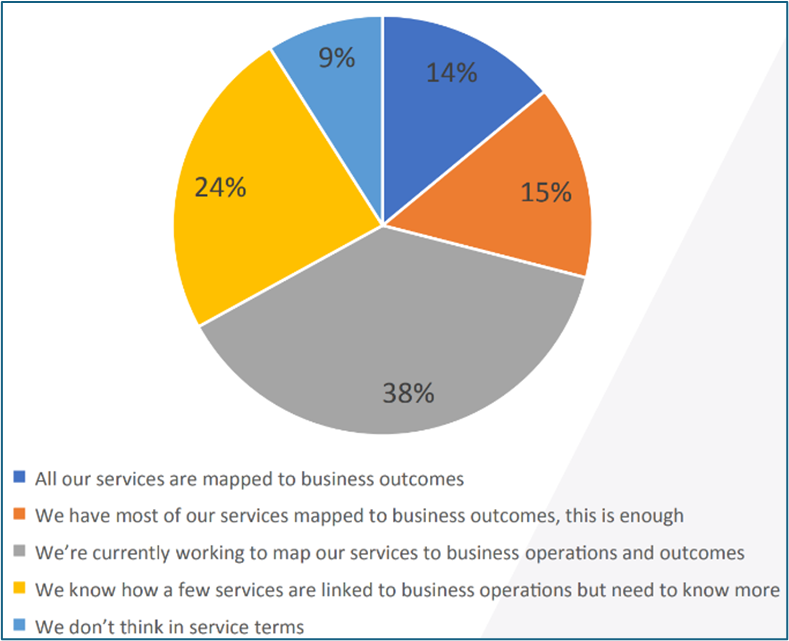
“Does your team understand how its services support business operations and success?” (Axelos ITSM Benchmarking Report, 2022)
Aware of the gaps and tension, PeopleCert hosted a series of ITIL Travels events in the USA in 2024, intending to advance understanding of modern digital service value delivery. At these events, David Cannon, Director for the Americas at PeopleCert and co-author of Digital and IT Strategy in ITIL 4, presented the ongoing evolution of the ITIL framework. Cannon illustrated how ITIL’s focus has expanded over time, from managing technology and operations to delivering services of measurable quality, and now, with ITIL 4, to building value in a digital world. This evolution reflects how the framework has adapted to broader business and technology realities, expanding from operational control to organizational value creation. The continued gap between these intentions and how ITIL is often practiced highlights why so many organizations still struggle to demonstrate value despite adopting the world’s most recognized service management framework.
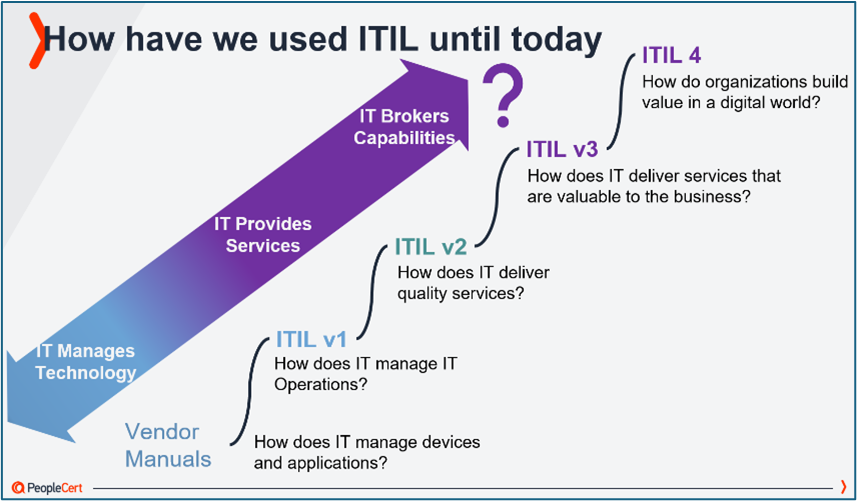
ITIL Roadshow in Washington, DC (Cannon, 2024).
Cannon also highlighted how this gap manifests in practice. Drawing on decades of experience advising global enterprises, he observed that many ITSM programs still emphasize operational activity such as resolving incidents, processing requests, and managing changes, while executives focus on innovation, growth, and transformation. The result is a growing separation between the language of operations and the language of outcomes. ITSM is seen as something that keeps the lights on rather than something that shapes where the organization is going.
David Cannon’s presentation of ITIL’s evolution since its inception in 1989 underscores how decades of practice have primed organizations to view ITIL through an operational lens. Early versions emphasized IT operations and service support, and the association with incidents, tickets, and helpdesk functions became the dominant shorthand. That framing persisted through training materials, vendor marketing, and reference glossaries, making it difficult for later versions to redefine ITIL’s broader purpose.
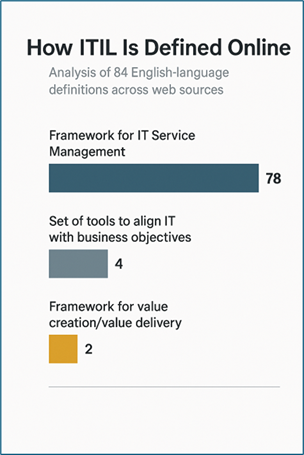
Source: Author’s independent analysis of 84 English-language web definitions of ITIL (2025).
This pattern only deepened as ITSM tool vendors, blogs, and secondary sources repeated the same definitions. Recent research confirms this trend. In a review of online explanations of “What is ITIL?”, the overwhelming majority defined it primarily as a framework for IT service management. Few mentioned business alignment, and fewer still introduced ITIL as a framework for value management or value delivery. When value was referenced, it appeared late in the description, secondary to the service management framing. This evidence shows how deeply the operational view of ITIL has become entrenched in public understanding, overshadowing its broader purpose.
Overcoming this persistent misalignment requires a shift in perspective. The operational framing of ITIL has real consequences. According to a 2025 industry review, organizations lose an average of $9.7 to $15 million each year due to operational inefficiencies, flawed decision-making, data silos, and poorly integrated systems[iii]. These problems are often rooted in the lack of alignment between technology and business units. They are not technology failures; they are value failures, where the absence of shared purpose and language limits the organization’s ability to turn technology investment into measurable outcomes.
Reframing ITIL takes steps toward addressing this gap. ITIL 4 reinforces the principle that value is co-created through collaboration between the organization and its stakeholders. Applied in this way, ITIL becomes a shared language for aligning technology decisions with organizational priorities and transformation.
In the sections that follow, we outline practical actions practitioners can take to reframe ITIL and apply it as a system for managing value rather than simply managing services.
Create a Value Register
ITIL already encourages practices such as maintaining a risk register and a continual improvement register. In the same spirit, organizations can strengthen their impact by creating a value register, which serves as a single source of truth for documenting the outcomes co-created through technology and business collaboration. In the fast pace of organizational life, it is easy for teams to move from one initiative to the next without pausing to reflect on what has been achieved. A persistent record of value keeps accomplishments visible, reinforces technology’s role in advancing organizational goals, and ensures that hard-won results are not lost amid day-to-day operations. Just as importantly, a value register provides opportunities to celebrate success, build momentum, and create a narrative of technology as a partner in achieving business outcomes rather than as a back-office utility.
Reframe the Risk and Improvement Registers
Most organizations already maintain risk and continual improvement registers, but these tools are often underutilized as instruments for demonstrating value. Risks are typically recorded to meet compliance obligations, and improvement opportunities are logged to support audits or maturity assessments. While these purposes are valid, they overlook an important opportunity. Both registers can be reframed as mechanisms for showing how technology decisions protect and enhance organizational value.
By linking each risk or improvement item to the outcomes it supports, practitioners can make value explicit. For example, reducing a cybersecurity risk does not simply mitigate potential loss; it protects the organization’s ability to operate, serve customers, and maintain trust. Similarly, an improvement initiative that streamlines workflow or enhances reporting directly contributes to performance and agility. When risks and improvements are expressed in terms of the value they safeguard or create, the organization begins to view IT management as a strategic capability rather than an operational overhead.
Manage and Communicate Project Value
A critical step in reframing ITIL for value is ensuring that every project begins and ends with a clear articulation of outcomes. Too often, projects are defined by scope, deliverables, and timelines, while the intended value is left vague or assumed. Technology leaders and practitioners can change this by making the value proposition explicit at the outset: why the project matters, how it will advance organizational priorities, and what success will look like when complete. At project closure, that same value proposition should be revisited to assess whether it was achieved and to communicate the results broadly. When maintained as a living portfolio, this discipline does more than track progress. It brings projects and their intended outcomes to the forefront, keeps them visible to leaders, and reinforces the portfolio as a shared source of organizational momentum. Just as a value register highlights realized outcomes, the portfolio emphasizes the value being pursued.
Make Governance Meaningful
Technology governance, when used effectively, becomes a catalyst for aligning decisions, priorities, and investments with organizational outcomes. Governance becomes meaningful when it provides a clear cadence for prioritization, keeps focus on strategic goals, and gives participants an opportunity to contribute visibly to the organization’s success. Too often, governance is experienced as a frustrating process, with meetings that lack clear purpose or result in decisions disconnected from outcomes. By positioning portfolio management as a foundation of governance, technology leaders can change that perception. Discussions shift from procedural updates to practical questions: Which initiatives create the most value? Where are risks to value emerging? How do we ensure the right outcomes are achieved? This approach sharpens decision-making and transforms governance into a forum for collaboration, where technology and business leaders work together to ensure that investments deliver lasting value.
Speak the Language of Organizational Value
Technology leaders can strengthen their influence by moving beyond technical terminology and demonstrating fluency in what matters most to business decision-makers. Executives focus on growth, customer experience, revenue, efficiency, and mission impact, not infrastructure or ticket counts. Value is perceptual: if leaders and stakeholders do not recognize technology outcomes as advancing their priorities, they will not experience them as value.
Building this fluency requires curiosity about how the organization defines success. Practitioners can study strategic plans, annual reports, financial statements, and board materials to understand the goals and language used by leadership. They can also look more closely at how individual departments express priorities by reviewing OKRs (Objectives and Key Results), team scorecards, job descriptions, and operational dashboards. Participating in planning sessions, business reviews, and cross-functional forums provides additional perspective on what drives decisions and how value is measured across the organization.
By grounding conversations in this shared language, technology professionals position IT as a co-creator of organizational value rather than a cost center. Over time, this shift in communication reframes ITIL practices as tools for enabling outcomes that leadership already understands and supports.
Make Value Measurable
Value must be expressed in ways that are specific and meaningful if it is to be credible. In addition to traditional metrics such as system uptime and ticket resolution, technology leaders should establish measures that reflect organizational outcomes and priorities.
One effective approach is to develop value models, similar to the incident models familiar in ITIL practice. Just as incident models provide a repeatable way to diagnose and resolve issues, value models create a structured method for identifying, defining, and tracking organizational value. These models can also serve as focal points for governance discussions, giving leaders a consistent way to examine how technology contributes to the outcomes that matter most.
Examples of value may include increased revenue, improved customer or employee experience, operational efficiency, and the ability to innovate or adapt quickly. Process improvements and automation generate capacity for higher-value activities, while strategic sourcing and technology rationalization demonstrate measurable financial impact.
For additional insight into making value measurable, Douglas Hubbard’s How to Measure Anything[iv] shows that even seemingly intangible outcomes can be quantified with the right methods. The ITIL 4 Measurement and Reporting Practice Guide[v] also provides practical direction for aligning measures with institutional objectives and ensuring data informs continual improvement. Used together, these resources help practitioners demonstrate value in terms that resonate with business leaders and strengthen technology’s position as a strategic partner.
Invest in Advanced ITIL 4 Training
The ability to reframe ITIL for value depends on building a shared foundation of knowledge. The recommendations in this paper draw heavily on concepts advanced in ITIL 4 publications such as Direct, Plan & Improve[vi] and Digital & IT Strategy. These works go beyond process mechanics to emphasize governance, strategy, innovation, and value co-creation. By investing in advanced ITIL 4 training and certification, technology professionals deepen their expertise, gain a common vocabulary with peers, and bring proven practices back to their organizations. Training sharpens individual capability and demonstrates a commitment to delivering technology as a source of organizational value.
Ultimately, the purpose of reframing ITIL is to enable practitioners and organizational leaders to work together creating outcomes that matter. The disconnect between organizational leadership and technology teams has persisted for decades, reinforced by narrow perceptions of ITIL as a helpdesk framework and by IT’s own tendency to emphasize operations over outcomes. Yet this perception is not fixed. By reframing ITIL around value through tools such as value, risk, and improvement registers, intentional portfolio management, meaningful governance, fluency in organizational priorities, and credible approaches to measuring outcomes, practitioners can reset the conversation.
With deliberate practice and ongoing learning, technology leaders can demonstrate that IT is not simply a service function but a co-creator of organizational success. The real cost of the disconnect is measured not just in lost efficiency or missed opportunity, but in the untapped potential of technology to help organizations adapt, grow, and lead. When ITIL is understood as a framework for managing value, it becomes more than a set of practices. It becomes a mindset for aligning technology with purpose and for realizing the full promise of digital leadership.
[i] Gartner. (2025, March). 2025 CIO Leadership Perspectives. Retrieved from https://www.evanta.com/resources/cio/infographic/2025-cio-leadership-perspective
[ii] PwC. (2025, July). Tech CIO Priorities in 2025. Retrieved from https://www.pwc.com/us/en/industries/tmt/library/tech-cio-priorities.htm
[iii] Integrate.io. (2025, September 27). 50 Statistics Every Technology Leader Should Know in 2025. Retrieved from https://www.integrate.io/blog/data-transformation-challenge-statistics/
[iv] Hubbard, D. W. (2014). How to measure anything: Finding the value of ‘intangibles’ in business (3rd ed.). Wiley.
[v] PeopleCert. (2023). ITIL® 4 measurement and reporting: Official practice guide. https://peoplecert.org/MyResources/library/Books/ITIL%204%20Measurement%20and%20reporting%20%20Official%20Practice%20Guide-531
[vi]PeopleCert. (2023). ITIL® 4: Direct, Plan, and Improve https://peoplecert.org/MyResources/library/Books/ITIL%204%20Direct%20Plan%20and%20Improve28
About the Author
Mike Alstrom is a seasoned technology executive with over 25 years of experience in technology leadership and managed services. He is a certified ITIL Master with a specialization in Acquiring and Managing Cloud Services (AMCS) and holds the Project Management Professional (PMP) certification. Mike has led teams through large-scale SaaS implementations, resource planning and delivery, and enterprise IT service optimization. His expertise spans IT service management, cloud strategy, business process analysis, and organizational performance improvement. He regularly contributes to thought leadership efforts that bridge operational efficiency with long-term value creation.
Sign in or Join the community
Where conversation, connection, and real-world practices come together.

Create an account
Where conversation, connection, and real-world practices come together.
7
Comments (5)
Popular

Popular
Dive in
Related
Blog
From Best Practices to Blue Oceans: ITIL as a Value Innovator
By Yurguen Penaranda Th... • Feb 2nd, 2026 • Views 54
Blog
Beyond IT Service Management: ITIL as a Strategic Enabler of Data Governance and Management
By Yurguen Penaranda Th... • Jun 16th, 2026 • Views 9
Blog
From Best Practices to Blue Oceans: ITIL as a Value Innovator
By Yurguen Penaranda Th... • Feb 2nd, 2026 • Views 54
Blog
Beyond IT Service Management: ITIL as a Strategic Enabler of Data Governance and Management
By Yurguen Penaranda Th... • Jun 16th, 2026 • Views 9