The Lifecycle That Finally Made It All Make Sense
Let’s take a look at our story! Take a walk through where we started, what we learned, and how the digital product and service lifecycle now brings everything together. The aim is to make the ideas easy to follow and to show, in a plain and simple way, how the lifecycle plays out in real life across IT Services.
You’ll see that for us, the lifecycle describes the whole of our world, but for some, the part can be the whole, and a subset of the activities is just as valid.
Once upon a time, our digital estate was shaped by projects on one side and operational services on the other. Our developers built things brilliantly, they handed them over, and moved on. The Service Desk picked up whatever arrived next. Everyone was working hard, but we had accidentally created gaps, duplicated effort, made messes in transition, and, worse still, we occasionally missed delivering what our colleagues and students actually needed. That resulted in fixes happening long after launch, and that hampers our chances of moving to new projects.
Every day at Runshaw, we felt the strain of that separation. App changes landed without the service lens, and operational improvements struggled to influence design early enough. Staff and students sometimes experienced inconsistent journeys because the value flowed through different teams with different assumptions, even though the destination was the same.
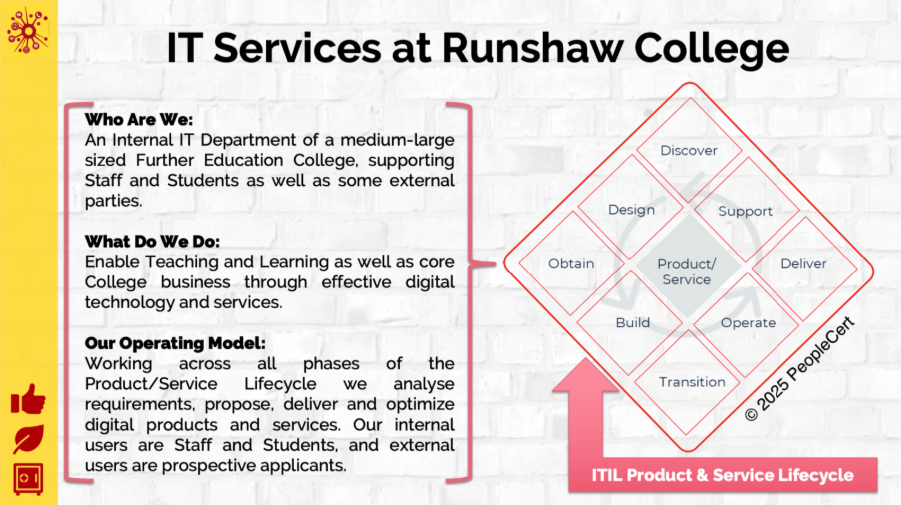
One day, we reframed everything around a fully integrated IT Services function. We didn’t know it yet, but we were working in line with what would become the ITIL digital product and service lifecycle. We used to think in terms of “projects then operations”, but now the lifecycle is a model, a storyline that describes our operation perfectly. We: Discover, Design, Obtain, Build, Transition, Operate, Deliver, and Support . This new way of working quickly brought clarity to ownership, visibility to flow, and a shared language across IT Services. It also aligned perfectly with the direction being championed in ITIL (Version 5), which I’m proud to help launch as a PeopleCert Ambassador.
Because of that, we reorganised our work around value streams and user journeys. Infrastructure, service desk and our systems development team now all contribute to the same lifecycle, instead of handing off and hoping for the best. Features, fixes and improvements move through the same pathways, which means that repeat issues feed straight into design, service insights shape delivery, and customers feel fewer bumps along the journey. It also means governance, security, and privacy by design happen at the right time, not bolted on at the end.
Because of that, our teams now have deeper visibility and clearer backlogs, shared goals, and more predictable flow. The service desk identifies patterns that guide problem work; systems and infrastructure teams use this insight to shape product changes. We see improvements through faster processing because we’re no longer losing context between every stage. The lifecycle helps us make better decisions about what to build, when to build it, and how it will work in the real world. It has also reduced digital friction, because each improvement considers not just the technology but the whole journey staff and students take.
Until finally, our digital products and services became one coherent system rather than a collection of good intentions. Our teams talk to each other earlier, deliver changes with fewer surprises, and share responsibility for outcomes and shared knowledge. Students and staff see better guidance, and they get more consistent experiences, and quicker recovery when things go wrong — because we’ve designed the lifecycle to support them, not just us.
In the future, we will have built our improvements around the new lifecycle. It undoubtably will be a huge factor in guiding our decisions, our governance, and our culture. ITIL (Version 5) gives us a shared framework for what we’ve already been doing: treating digital products and services as one continuous flow of value, shaped by people, powered by good practice, and measured by real human experience. If you’re exploring digital product and service lifecycle thinking, then I’d be very interested in your progress and how you see this impacting our industry as a whole.
#DigitalProducts #DigitalServices #ServiceLifecycle #ITIL5 #ITSM #DPSM #PeopleCert #ValueStreams #DigitalTransformation #FE #PublicSector