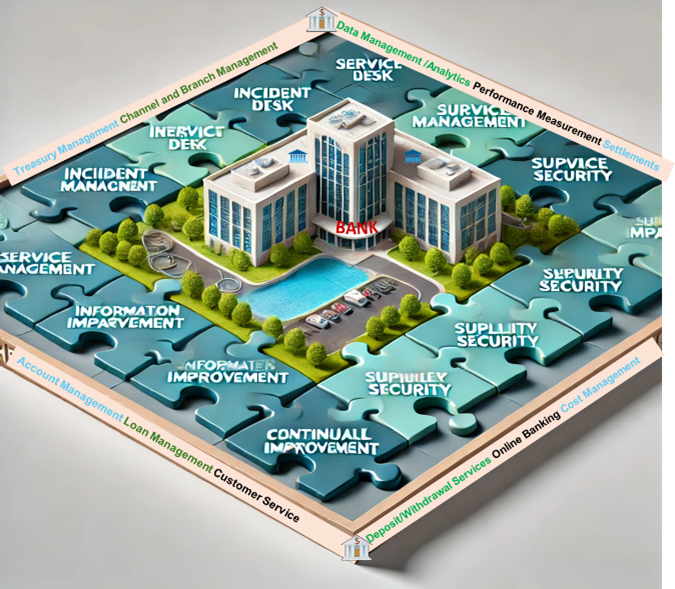
Banks and Financial Institutions face ever-increasing demands to ensure the security, speed, and reliability of their services. Meeting regulatory requirements, protecting customer data, and delivering seamless service experiences are critical to maintaining trust and staying competitive.
Service Management in Financial Institutes plays a pivotal role in ensuring efficient operations, enhanced customer service, and improved data security. By integrating ITIL frameworks, banking institutions can:
- Secure Customer Data Integrity and Transactions
- Provide Omnichannel Real-Time Access
- Enhance Regulatory Compliance and Fraud Prevention
This approach leads to increased customer satisfaction, operational resilience, and greater trust in financial services, contributing to the growth and stability of the financial sector.
Value in Banking = Reliable, Secure, and Efficient Financial Services
Use Case: ITIL Adoption in a Major Financial Institution
Institution: Continental Bank & Trust
Challenge 1: Continental Bank faced increasing demands for faster, more reliable customer service, which strained existing IT systems. Service interruptions, delays in transaction processing, and a lack of centralized IT management impacted customer satisfaction.
Challenge 2: The bank needed to enhance compliance with stringent financial regulations while mitigating the risks of data breaches, fraudulent transactions, and system downtimes.
Solution: Continental Bank adopted ITIL as its Service Management Framework, integrating processes like Incident Management, Change Management, Problem Management, and Service Level Management across its IT operations. A centralized IT service desk was established to manage and resolve customer and system issues efficiently, ensuring a seamless banking experience.
Key ITIL Implementations
- Customer Data Management: Ensuring secure, real-time access to customer transaction records, account information, and automated fraud alerts to minimize risks and enhance customer trust.
- Incident & Problem Management: Implementing structured processes to reduce system downtime, address service disruptions quickly, and prevent recurrence of issues.
- Change Management for Digital Services: Facilitating smooth upgrades and rollouts of digital banking platforms, mobile apps, and new customer features without disrupting service delivery.
So, Why ITIL for Your Financial Institution?
- For Customers: Faster, more reliable service and enhanced security for sensitive financial data.
- For Operations: Reduced costs, streamlined processes, and improved response times for IT-related incidents.
- For Regulatory Compliance: Enhanced security protocols and governance frameworks to meet industry regulations and minimize risk.
Outcomes and Measurable Improvements
1. Enhanced Customer Experience
· Reduced Transaction Processing Times: Faster transaction approvals and processing led to a 25% improvement in customer service times.
· Automated Alerts and Notifications: Fraud detection alerts reduced unauthorized transactions by 30%, enhancing customer security.
· Data-Driven Insights: Advanced analytics flagged high-risk activities, reducing compliance violations by 20%.
2. Increased Operational Efficiency
· Reduced System Downtime: Incident Management processes minimized downtime by 40%, keeping critical banking systems operational.
· Faster Problem Resolution: IT issue resolution times decreased by 35%, allowing for quicker resumption of banking services.
· Optimized Resource Allocation: Strategic Change Management led to a 15% reduction in operational costs.
3. Improved Regulatory Compliance and Data Security
· Compliance Assurance: Enhanced governance and data security protocols achieved a 0% data breach rate, minimizing penalties and protecting customer trust.
· Fraud Prevention: Increased fraud detection accuracy and transaction monitoring led to a 95% reduction in fraudulent activities.
Advanced Applications in Financial Services
ITIL-based frameworks also support innovative services such as AI-driven fraud detection, predictive analytics for customer behavior, and blockchain integration for secure transactions. These applications ensure a resilient, forward-thinking approach to Service Delivery and Financial Security.