OODA or the Proper Entry Point to Integrate AI into Service Value Stream Enhancement
This is something we encounter daily. There is no discussion without mentioning the impact of AI, no keynote without emphasizing the importance of adapting to new market drivers and technologies in the business ecosystem of IT service providers. No digitalization without AI. But one question remains: Where do we start?
Under these circumstances, executives may sponsor and charter AI projects (the standard situation), perhaps define an AI strategy (a better situation), or develop a strategically aligned AI integration roadmap (the best case). But you may realize one thing: most organizations have not even reached the standard situation. There is often only an undefined gut feeling about a strategic direction, far from anything that could be called a “roadmap.”
Exactly this situation existed three years ago in my professional environment. Let me share how we solved it and why I am now pleased that the new ITIL guidance confirms what we did at the time. The core question was simple: Where are we now, and where do we want to be?
So what did we do? The solution may seem too simple to the reader. But in the end, it worked. We moved forward step by step. The only real question was: What do we mean by “the way forward”? And which steps should be taken?
Because the journey itself is volatile, sometimes unclear, sometimes full of obstacles and unexpected influencing factors (chaotic), or running along unexpected crossroads (ambiguous), we were essentially planning a strategy in a VUCA environment.
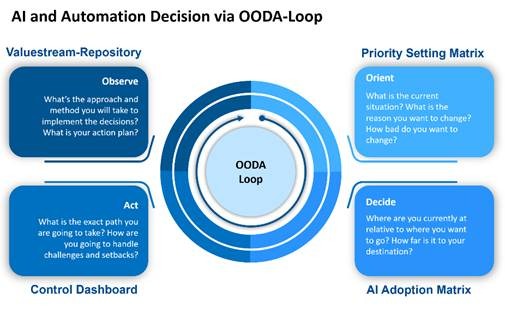
One possible approach (certainly not the only one) is to proceed step by step through structured decision-making. You start with the strategic intent of the organization (Principle One – Value). You look at what is currently happening around you (Observe), set priorities (Orient), Decide, and then Act.
OODA loop was used long before it became popular in high-velocity IT or the Agile movement. It originated in the military (air battle simulations and later hybrid warfare), but it has long been used in business planning by companies that are already considered “digital.”
The only thing we needed to add was the use of artifacts to give management an instrument to proceed with a structured approach. This helped prevent patchwork initiatives, loss of synergies, damage to the overall strategic objective, or even the expansion of what is often called the strategic execution gap—the difference between what management intends and the outcomes actually achieved.
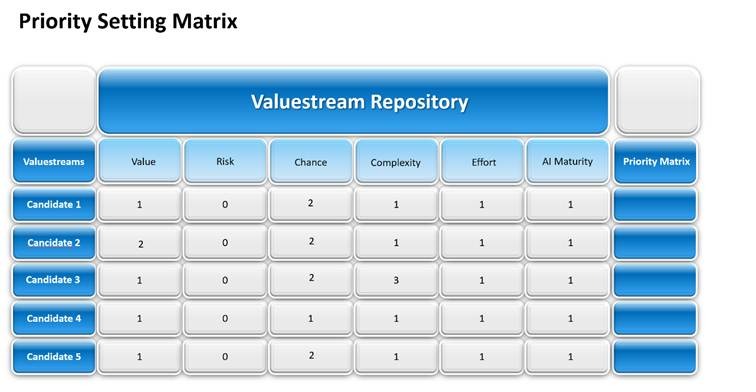
We therefore treated each value stream in the organization as a configuration item. We inventoried them as candidates and scored them using a matrix that might already exist in the organization’s change control process. Starting from the overall strategic intent, we asked a simple question:
What would be the impact if we added automation or artificial intelligence as an enabling or supporting capability to Candidate X?
After completing this step, we had a provisional priority list.
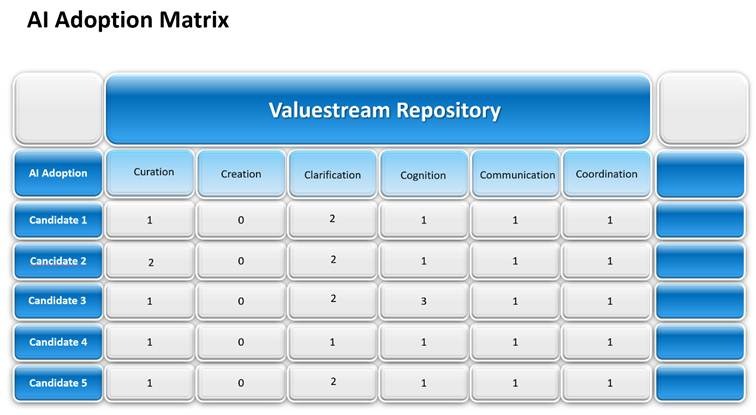
The next step was to determine which type of capability should be integrated into the value stream. If you consider AI not in terms of the many buzzwords circulating today (LLMs, agentic AI, chatbots, RAG, DI, etc.), but instead focus on what capabilities a digital twin should provide, you can score the pre-sorted value stream candidates and optimize the AI activity portfolio for the final roadmap.
What made me particularly happy after reading the ITIL (Version 5) Foundation book was that the authors also considered a similar approach. When discussing possible AI scenarios in digital ITSM, the wording strongly reflects this capability-based approach.
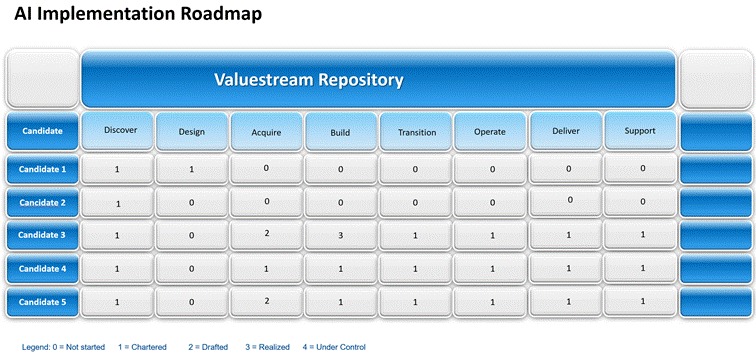
Ultimately, it became quite straightforward to draft a roadmap for integrating AI and automation into the company’s service value stream landscape.
I will not show the original roadmap control chart from the project three years ago. If we had known about ITIL (Version 5) at that time, we might have structured it like this instead.
What you see here is a roadmap for AI implementation aligned with lifecycle steps.
Why take this approach? Every ITSM practitioner knows that a value stream is the result of a stack of selected, enriched, and optimized building blocks taken from the thesaurus of practice guides. Following this logic provides several advantages:
- You can manage each value stream like a configuration item
- You can align each value stream with strategic priorities
- You can plan the technology stack beneath value streams, similar to enterprise architecture
- You avoid building isolated solutions instead of integrated and manageable architectural building blocks
- You preserve the organizational agility needed to operate effectively in today’s VUCA business conditions
Enjoyed this post? Join the conversation by leaving a comment or sharing your thoughts below, we’d love to hear your experiences and perspectives. Don’t forget to explore our upcoming events for more opportunities to learn and connect, and visit the forum to continue the discussion.