Don’t Start with the 34 Practices: Assess IT Maturity Through the ITIL Operating Model
# ITIL
# Leadership Insights
Discover how connected practices and real work scenarios reveal IT maturity and guide meaningful improvement.
November 12, 2026
Hiroyuki Naka
Don’t Start with the 34 Practices: Assess IT Maturity Through the ITIL Operating Model
Improvement starts with an objective understanding of the current state.
ITIL provides a structured set of considerations for planning, developing, delivering, operating, and improving IT services. However, when conducting an ITIL Version 5 maturity assessment, simply turning all 34 practices into 34 separate assessment areas is not always the most effective approach.
In real IT organizations, practices such as Incident Management, Problem Management, Change Enablement, and Service Level Management do not operate independently.
A service is identified, designed, built, transitioned into production, operated, delivered to users, supported, measured, and improved. Multiple practices work together throughout that journey.
This is why an ITIL maturity assessment should not start with the individual practices.
It should start with the ITIL Operating Model.
Use the ITIL Operating Model to Understand How the Organization Actually Works
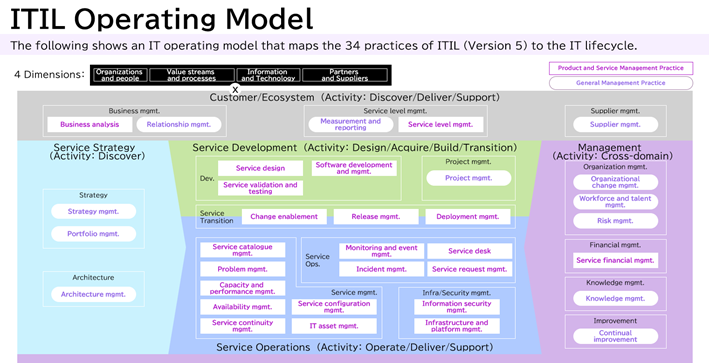
The ITIL Operating Model can be viewed through several major areas of activity.
Service Strategy
Activity: Discover
Service Development
Activities: Design / Acquire / Build / Transition
Service Operation
Activities: Operate / Deliver / Support
Management
Activity: Cross-cutting management across the lifecycle
Surrounding these areas is the:
Customer & Ecosystem
perspective, which plays an important role particularly in Discover, Deliver, and Support activities.
The entire operating model should also be considered through the Four Dimensions of Service Management:
- Organizations and People
- Value Streams and Processes
- Information and Technology
- Partners and Suppliers
This structure allows the 34 ITIL practices to be understood not as an isolated checklist, but as a set of capabilities that together form the operating model of the IT organization.
Service Strategy: Determine What Should Be Provided and Why
Service Strategy is primarily associated with Discover activities.
The organization needs to understand business needs, customer expectations, existing capabilities, architectural constraints, risks, and investment priorities before deciding what services should be created or changed.
Relevant practices include:
Strategy Management, Portfolio Management, and Architecture Management.
These also interact closely with practices such as:
Business Analysis and Relationship Management
within the Customer & Ecosystem area.
Instead of asking:
“Do you have a Strategy Management process?”
a maturity assessment can ask:
“When planning a new service or system, does the organization consider business strategy, customer needs, the existing service portfolio, and architectural direction before making an investment decision?”
The important question is not whether the practice exists in isolation.
It is whether the required practices are actually working together when strategic decisions are made.
Service Development: Turn an Idea into an Operable Service
Service Development covers the flow from:
Design → Acquire → Build → Transition
Relevant practices include:
Service Design, Software Development and Management, Service Validation and Testing, Project Management, Change Enablement, Release Management, and Deployment Management.
A typical flow might involve:
Define requirements
→ Design the service
→ Develop or configure it
→ Validate and test it
→ Approve the change
→ Release it
→ Deploy it into production
From a maturity perspective, the key question is not simply whether each activity is performed.
The more important question is:
Do these practices work together as an end-to-end value stream from design through transition?
For example, software development may be highly mature, but the overall operating model is still weak if monitoring requirements, operational procedures, configuration information, or support arrangements are not ready at go-live.
The operating model therefore helps assess not only whether a service can be built, but whether it can be made operationally ready.
Service Operation: Deliver Stable and Reliable Services
Service Operation focuses on:
Operate / Deliver / Support
and includes practices such as:
Monitoring and Event Management, Incident Management, Problem Management, Service Desk, Service Request Management, Service Configuration Management, IT Asset Management, Availability Management, Capacity and Performance Management, and Service Continuity Management.
Consider a typical incident scenario:
Monitor
→ Detect
→ Create an incident
→ Investigate
→ Restore service
→ Analyze the root cause
→ Prevent recurrence
This is clearly not the responsibility of Incident Management alone.
Monitoring, configuration information, knowledge, problem management, and other practices must work together.
Therefore, rather than asking:
“How mature is Incident Management?”
the assessment should ask:
“How effectively can the organization detect an issue, restore service, identify the underlying cause, and prevent recurrence?”
That question evaluates the actual operating model rather than a single process.
Customer & Ecosystem Is Part of the Operating Model
IT services are not delivered by the IT organization alone.
Customers, users, outsourcing partners, cloud providers, technology vendors, and other suppliers all participate in the service ecosystem.
Practices such as:
Business Analysis, Relationship Management, Measurement and Reporting, Service Level Management, and Supplier Management
connect the IT organization with this ecosystem.
Service Level Management provides a good example.
It should not begin only after the service has gone live.
Customer expectations should be understood during discovery and design, service levels should be defined, actual performance should be measured during operation, and the results should lead to review and improvement.
The flow becomes:
Discover
→ Design
→ Deliver
→ Measure
→ Improve
The maturity assessment should therefore examine whether customer and supplier relationships are embedded into the service lifecycle rather than managed as isolated activities.
Management Practices Enable the Entire Operating Model
Some ITIL practices are inherently cross-cutting.
Examples include:
Organizational Change Management, Workforce and Talent Management, Risk Management, Service Financial Management, Knowledge Management, and Continual Improvement.
These practices support Service Strategy, Service Development, and Service Operation as a whole.
For example, even a well-designed Incident Management process may fail to deliver results if:
- The organization lacks the required skills
- Knowledge is not captured or reused
- Supplier responsibilities are unclear
- Risks are not escalated appropriately
- Improvement initiatives cannot obtain funding
This means that maturity cannot be assessed only at the process level.
The organization must also assess the management capabilities that enable the operating model to work sustainably.
Assess Maturity Through the Four Dimensions
The Four Dimensions of Service Management add another important layer to the maturity assessment.
Take Incident Management as an example.
The assessment should not only ask whether the process exists.
Organizations and People
Are roles and responsibilities clear?
Are the right skills available?
Is escalation working effectively?
Value Streams and Processes
Is there a clear flow from detection through restoration and problem resolution?
Does the process connect to improvement activities?
Information and Technology
Are monitoring tools, ITSM platforms, CMDBs, knowledge bases, and other technologies integrated effectively?
Can teams access the information they need?
Partners and Suppliers
Do external suppliers participate effectively in incident resolution?
Are responsibilities and service commitments clear?
Only when these four dimensions are considered together can the organization assess the maturity of the operating model, rather than just the maturity of a documented process.
Start the Assessment from Real Work Scenarios
Once the ITIL Operating Model becomes the foundation of the assessment, the questions themselves can also change.
Instead of interviewing people practice by practice, the assessment can begin with familiar business and operational scenarios.
For example:
When Planning a New Service
Assess Strategy Management, Portfolio Management, Business Analysis, Relationship Management, and Architecture Management.
When Designing and Building a Service
Assess Service Design, Software Development and Management, Information Security Management, Supplier Management, and related practices.
When Changing a Production Service
Assess Change Enablement, Release Management, Deployment Management, and Service Configuration Management.
When Operating a Service
Assess Monitoring and Event Management, Incident Management, Problem Management, Availability Management, and related practices.
When Supporting Users
Assess Service Desk, Service Request Management, Service Level Management, and Relationship Management.
This approach allows participants to respond based on work they actually perform, even if they are not experts in ITIL terminology.
The Connections Between Practices Matter More Than Individual Scores
A maturity assessment may produce results such as:
“Incident Management: Level 3”
“Change Enablement: Level 4”
These scores are useful, but they do not tell the whole story.
From an operating-model perspective, the connections between activities are equally important.
Service Strategy → Service Development
Are business requirements translated into clear service requirements?
Service Development → Service Operation
Are monitoring requirements, configuration information, operational procedures, and knowledge transferred to the operations organization?
Service Operation → Improvement
Do incidents, problems, SLA results, and KPI trends generate improvement actions?
Improvement → Service Strategy
Do improvement outcomes and user feedback influence future priorities and investment decisions?
An organization may have mature individual practices and still operate poorly if these handoffs are weak.
This is why the maturity of the connections between practices and operating-model areas is as important as the maturity of the practices themselves.
The Goal Is Not to Measure ITIL Compliance
The purpose of an ITIL maturity assessment should not simply be to determine how completely an organization has implemented all 34 practices.
The more important question is:
Can the IT operating model consistently turn business needs into reliable services, deliver those services effectively, and improve them continuously?
To answer that question, the assessment needs to combine:
34 ITIL Practices
× ITIL Operating Model
× Value Streams
× Four Dimensions of Service Management
ITIL should therefore not be treated simply as a library of best practices or an assessment checklist.
It can be used as a model for understanding how the IT organization actually operates, where the connections are weak, and where improvement will have the greatest impact.
That is the real value of using the ITIL Operating Model as the foundation for maturity assessment.
Enjoyed this post? Join the conversation by leaving a comment or sharing your thoughts below, we’d love to hear your experiences and perspectives. Don’t forget to explore our upcoming events for more opportunities to learn and connect, and visit the forum to continue the discussion.
Sign in or Join the community
Where conversation, connection, and real-world practices come together.

Create an account
Where conversation, connection, and real-world practices come together.
1
Comments (0)
Popular

Dive in
Related
Blog
From Managing Tickets to Managing Value: My ITIL Journey Through Enterprise IT Operations
By Binoy Mathews Pandi... • Oct 13th, 2026 • Views 44
Blog
The New ITIL Version 5: What It Means in the Real World of Digital Services
By Scott Everett • Feb 5th, 2026 • Views 168
Blog
Why the new ITIL is not just for IT Courses
By Pablo Leonardo Yambo... • Feb 9th, 2026 • Views 354
Blog
Creative ITIL® Implementation: Practicing the Framework Before It Is Formally Adopted
By Linda Lenox • Feb 26th, 2026 • Views 74
Blog
From Managing Tickets to Managing Value: My ITIL Journey Through Enterprise IT Operations
By Binoy Mathews Pandi... • Oct 13th, 2026 • Views 44
Blog
Why the new ITIL is not just for IT Courses
By Pablo Leonardo Yambo... • Feb 9th, 2026 • Views 354
Blog
Creative ITIL® Implementation: Practicing the Framework Before It Is Formally Adopted
By Linda Lenox • Feb 26th, 2026 • Views 74
Blog
The New ITIL Version 5: What It Means in the Real World of Digital Services
By Scott Everett • Feb 5th, 2026 • Views 168