Simulations - Step Change Learning and Have Fun Doing So
# PRINCE2
# ITIL
Using simulations to teach PRINCE2, P3M, Agile, Risk management (also ITIL!)
June 17, 2026
Pablo Leonardo Yambot
Simulations - Step Change Learning and Have Fun Doing So
Many of the most skilled professionals use simulations. Even more than Gen AI, well-designed simulations are game changers for learning and training. Simulations have helped prevent accidents and worse, in transportation, energy, disaster response, and defense.
Why simulations?
I made a career shift from engineering and manufacturing to IT in 2002. I took up several courses, including programming in Java, MS SQL, and HTML. I joined management trainees in onboarding courses. The most memorable of these was a supply chain overview, helped in no small part by a tabletop board game simulation- the Beer Game.[1]
Ever since I started teaching continuing and higher education sixteen years ago, I’ve incorporated simulations and board games as best I could. These simulations usually get the most glowing feedback as fun, memorable, and most importantly, effective and educational activities.
Modern frameworks such as ITIL, PRINCE2, and DevOps are meant to guide professionals and organizations through complex, real-world decision-making—yet they are often taught in traditional, millennia-old lectures, augmented with slides and, at most, videos.
Seasoned facilitators and trainers will use case studies, drawing on real-world experience, to apply theories and Bloom’s taxonomy levels 3 and 4. This helps learners apply, interact, and learn much more than just listening to lectures, watching videos, or reviewing for exams.
But learners who go through a full day’s worth, or even several days’ worth of training, almost always experience information overload and minimal retention. Those focused on exams will study enough of the material and helpful sample papers. But for employers, the actual learning and retention leave much to be desired.
Practitioners may understand the terminology, processes, or principles, but still struggle when faced with the realities of live services, constrained projects, or competing portfolio priorities. Traditional training methods, while necessary, rarely replicate the dynamic, cross-functional environments where these frameworks must operate.
Simulation-based learning addresses this gap by shifting the focus from knowledge acquisition to capability development. Through immersive, decision-driven scenarios, participants experience how actions unfold over time, how trade-offs emerge, and how interconnected practices influence outcomes. This is particularly valuable in environments where success depends not just on what people know, but on how they think, collaborate, and respond under pressure. For professionals across IT service management, project delivery, and PMO leadership, simulations offer a practical pathway from theory to confident execution.
What are simulations?
What do we mean by simulation? In training and professional development, simulations are commonly defined as structured learning experiences that recreate important aspects of real-world environments, so participants can make decisions, practice skills, and see consequences in a safe setting.[2] This sits within the broader tradition of experiential learning: learning by doing, reflecting, and adjusting rather than only listening, reading, or memorizing.[3]
Simulations have been used even before the advent of computers. Armed forces have both tabletop exercises - essentially manual, ‘gameboard’- to computer-based war games to real-world military exercises. Players and learners have used board games simulating everything from running a factory to supply chains (e.g., the famous beer game) to learn.
Computers have made simulations even more realistic and ubiquitous. From driving an ambulance to piloting a train or an Airbus A380 superjumbo airliner, to piloting spacecraft, complex, risky roles have benefited greatly from simulations.
At its core, simulation-based learning puts you in a realistic scenario where you have to make decisions, work with others, and deal with the consequences—just like you would on the job. It’s not about passively discussing what should happen (or how best to answer a certification exam question!); it’s about experiencing what does happen when conditions change, pressure builds, and information is incomplete.
This idea isn’t new. High-stakes professions have relied on simulations for decades. NASA’s Artemis II team ran countless simulations to rehearse anomalies and decision-making under pressure. Air force and commercial pilots and crews spend hours in flight simulators before ever taking real flights. Even school bus drivers in some regions use simulators to safely practice hazard perception and emergency response. The common thread is simple: when the cost of getting it wrong is high, practice needs to feel as real, to train the human to make the right, split-second, high-stakes decisions correctly.
In the world of ITIL, PRINCE2, and P3M, DevOps, simulations follow the same principle—but in a business context (and slightly less life & death critical situations). These can take different forms. Some are digital, using software to model projects, services, or portfolios over time. Others are more hands-on, such as facilitated workshops or tabletop exercises. Board-style simulations—often designed like structured games—are especially effective, using roles, rules, and evolving scenarios to bring governance, prioritization, and collaboration to life in a very tangible way. Disaster recovery drills have long used tabletop drills, essentially simulations, to check the readiness and correctness of continuity plans. Even regular earthquake and fire drills can be seen as a form of simulation.
No matter the analog, digital, or hybrid format, simulations share a few essential features that make them effective learning experiences:
· Participants take on a role or perspective.
· They make decisions within defined constraints.
· They observe the consequences of those decisions.
Together, these elements turn abstract concepts into practical experiences that people can engage with, reflect on, and learn from without the costly, potentially career-limiting or ending mistakes in real-life situations.
How to incorporate simulations:
As with any digitally enabled approach, simulations are not silver bullets. Some key watchouts:
1. Plan and design: simulations won’t magically transform a poorly designed or badly delivered workshop or course into a good one. They should be designed and delivered to complement the learning objectives and outcomes, not be the focus.
2. Plan and integrate: One may also overdo it; having too many simulations could result in de-emphasizing other equally important learning modes. Carefully put just enough simulations in a course. I personally find one simulation as a culminating or penultimate activity for a 16–20-hour course appropriate.
3. Practice: For more complex simulations, have trial runs for the facilitation and the learners. Get colleague(s) or student assistants to test-run team simulations. If applicable, have students try the less complex scenarios. For an academic course, have more of the grade focus on the lessons learned or reflection, instead of the simulation score.
4. Budget properly: don’t skimp on course simulations. Good ones may be pricey, but having too many learners in a group, especially for those that can be done by an individual, will detract from the learning experience (or be rightfully seen as the trainer saving money).
5. Continual learning: elicit specific feedback by ensuring your course feedback has questions on the simulations used. These would greatly help improve future course runs, learning experiences, and effectiveness.
Conclusion:
Frameworks such as ITIL, PRINCE2, and DevOps are only valuable when applied in real decisions. Simulations provide a safe but realistic environment to practice those decisions and applications and are thus powerful complements in training and certification—turning knowledge into action.
As organizations’ digital products, services, and portfolios grow more complex, experiential learning will become even more essential for building confident, capable practitioners and organizations.
Try some of my recommended simulations and see how you can have fun while learning.
Recommended simulations for ITIL, PRINCE2, value streams:
1. Value streams and supply chains - Beer Game, from ‘a classic role-playing game developed at MIT in the 1960s- originally, the ‘Beer Distribution Game’), – freemium version: https://beergameapp.com/
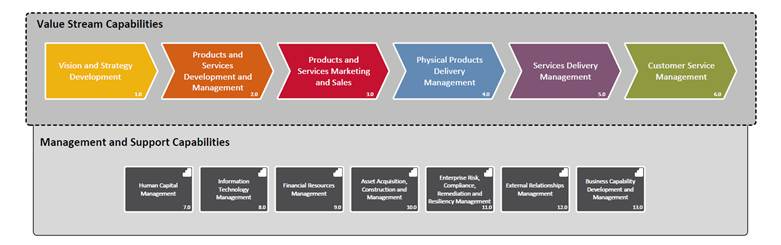
Value stream- will be simulated in the beer game.
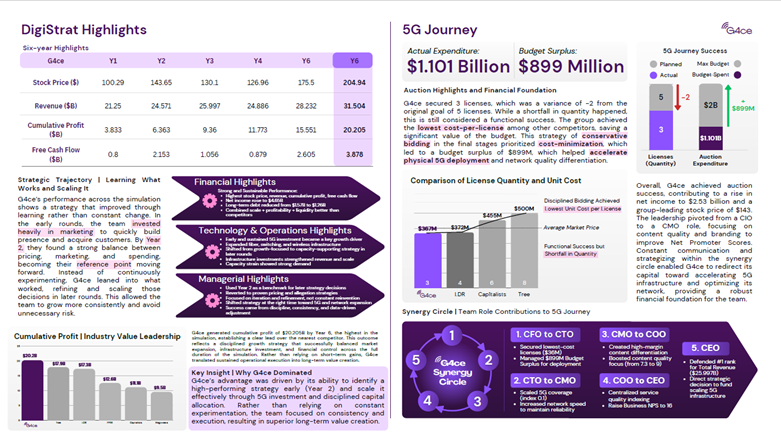
2. Strategy, business, portfolio, programme management- DigiStrat Digital Services Strategy Simulation (Northwestern Kellogg School of Management) Telecommunications company- Digital product and ICT management- competing with other telco companies in B2B, B2C, bidding for and investing in 5G, data, services for market share, profit, customer satisfaction to grow shareholder value.
Sample, University course output (groups of 5 to 6 BS Management of Information Systems seniors):
3. Project Management- Project Management Simulation: Scope, Resources, Schedule V3. Students take on the role of a senior project manager and manage a team tasked with developing a new product, implementing software, or delivering emergency relief efforts. (Harvard Business Impact) https://hbsp.harvard.edu/product/7701-HTM-ENG
4. Digital Product and Service Management (ITIL) - IT Management Simulation: Cyber Attack! Winner of the 2019 International Serious Play Gold Medal Award. This engaging simulation teaches students (who play the role of an A-level IT leader) key issues faced by managers when responding to an IT crisis. (Harvard Business Impact) https://hbsp.harvard.edu/product/8690-HTM-ENG
5. Environmental, Social, and Governance- sustainability - Finsimco Simulation: ESG Negotiation: Students take on roles as corporate managers, investors, regulators, or union representatives, each with distinct objectives and competing incentives. The simulation revolves around a company needing to finance upgrades for non-compliant products. (Harvard Business Impact) https://hbsp.harvard.edu/product/FS0009-HTM-ENG
[1] Originally, MIT Sloan School of Management’s The Beer Distribution Game originated in 1960. This seminal game is available online from online platforms, including a freemium version: beergameapp.firebaseapp.com
[2] Association for Talent Development. (2023, October 15). Four experiential learning activities for corporate programs. ATD. https://www.td.org/content/professional-partner-content/four-experiential-learning-activities-for-corporate-programs
[3] Interplay Learning. (2024, June 15). Simulation vs. experiential learning in training. https://www.interplaylearning.com/blog/simulation-learning-vs-experiential/
Sign in or Join the community
Where conversation, connection, and real-world practices come together.

Create an account
Where conversation, connection, and real-world practices come together.
Like
Comments (0)
Popular

Dive in
Related
Blog
A Tale of Two Projects: Capturing Risks vs Managing Risks
By Tomos Jones • May 14th, 2026 • Views 31
Blog
Beyond Automation: How Agentic AI Redefines the PRINCE2 Delivery Layer and Project Roles
By Nooreddin Tahayneh • May 12th, 2026 • Views 29
Blog
A Tale of Two Projects: Capturing Risks vs Managing Risks
By Tomos Jones • May 14th, 2026 • Views 31
Blog
Beyond Automation: How Agentic AI Redefines the PRINCE2 Delivery Layer and Project Roles
By Nooreddin Tahayneh • May 12th, 2026 • Views 29