Navigating the Modern Service Ecosystem
# Service Management
A Strategic Blueprint for Service Relationships
August 4, 2026
Rauf Aliyev
Navigating the Modern Service Ecosystem: A Strategic Blueprint for Service Relationships
In today’s hyper-connected digital economy, no enterprise operates in a vacuum. Whether deploying global cloud architectures or managing complex corporate training ecosystems, the modern organization’s success depends entirely on how effectively it structures, manages, and matures its external and internal service relationships.
Within modern service management frameworks, an organization is defined as any person or group of people with its own distinct functions, responsibilities, authorities, and relationships to achieve specific objectives. This broad definition means that service dynamics apply universally—whether we are analyzing a multinational corporation, a specialized team within a business unit, or a self-employed consultant.
Within every service interaction, organizations play two fundamental roles: the service provider (responsible for delivering and supporting the service) and the service consumer (responsible for procuring and utilizing the service). Furthermore, in an era dominated by software-driven business models, the service provider often merges with the role of a digital product vendor—the entity responsible for building and continually improving the underlying digital assets and offerings.
Understanding these roles is only the first step. To drive true business value, organizations must master the internal anatomy of the service consumer, choose the appropriate depth of relationship engagement, and carefully navigate the non-linear path of the service journey.
1. The Anatomy of the Service Consumer: Aligning the Triple-Role Dynamic
A common pitfall in vendor and service management is treating "the customer" as a single, homogenous entity. In professional environments, the service consumer role is actually a composite of three distinct stakeholders, each with unique motivations, metrics, and definitions of value:
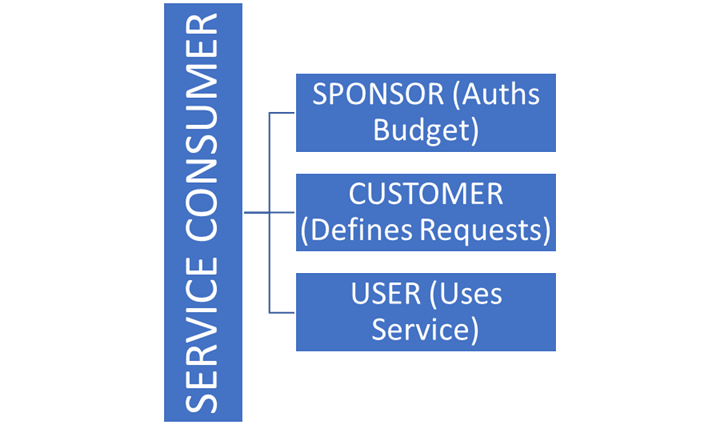
· The Sponsor: The individual or group that authorizes the budget for service consumption. They are focused on Return on Investment (ROI), cost-efficiency, and financial predictability.
· The Customer: The stakeholder who defines the requirements for products and services, negotiates service level agreements (SLAs), and takes ultimate responsibility for the outcomes of service consumption.
· The User: The actual persona interacting with the service on a daily basis to perform their tasks. Their primary focus is usability, reliability, and friction-free experiences.
Real-World Enterprise Scenario: The Cloud ERP Migration
Consider a large-scale logistics company migrating its legacy supply chain systems to a managed cloud ERP platform. To manage this relationship effectively, the provider must engage with all three aspects of the consumer:
- The Sponsor (CFO): Approves the capital expenditure and subscription licensing models. The CFO’s definition of value is centered on reducing operational overhead and shifting capital expenses (CapEx) to operating expenses (OpEx).
- The Customer (CIO & IT Director): Designs the technical specifications, negotiates data security protocols, and monitors the provider's adherence to system availability SLAs.
- The Users (Warehouse Managers & Dispatchers): Use the system to log shipments, track inventory, and generate manifests. If the UI is slow or unintuitive, they experience frustration, even if the system meets the CIO's availability SLAs.
In a business-to-business (B2B) environment, ignoring the distinctions between these three roles leads to misalignment, poor user adoption, or canceled contracts. Conversely, in a direct-to-consumer (B2C) scenario—such as an individual purchasing a personal mobile subscription—all three roles converge into a single individual.
2. Archetypes of Engagement: Three Types of Service Relationships
Organizations must consciously design their service relationships rather than letting them form organically. The level of resource sharing, operational dependency, and risk integration dictates the type of relationship required.
Service management recognizes three core types of service relationships: Basic, Cooperative, and Collaborative (often referred to as a Strategic Partnership).
Strategic Dimension | Basic Relationship | Cooperative Relationship | Collaborative Relationship (Partnership) |
Primary Focus | Operational efficiency and baseline support | Continuous improvement and operational effectiveness | Joint innovation, market growth, and shared value |
Organizational Alignment | Operational level | Operational and tactical levels | Operational, tactical, and strategic levels |
Service Characteristics | Highly standardized, out-of-the-box commodity services or off-the-shelf goods | Configured, tailored, or customized managed services | Highly bespoke, co-created services with unique value propositions |
Agreement Style | Standardized, mass-market contracts and generic SLAs | Advanced, outcome-based SLAs or Experience Level Agreements (XLAs) | Bespoke, risk-sharing agreements or mutual trust-based frameworks |
3. Deconstructing the Relationships in Action
To understand how these relationship dynamics function in practice, let us examine three distinct enterprise case studies.
Case Study A: The Commodity Internet Supply (Basic Relationship)
A regional commercial bank contracts a national telecom provider to supply broadband internet connection to its 50 retail branches.
- The Dynamic: The bank is consuming a standardized utility service. There is no customization; the bank simply plugs its routers into the telecom's pre-existing network.
- The Governance: The relationship is purely operational, managed via standard online portals and automated troubleshooting tickets. Communication only occurs during outages or billing cycles. This basic model is highly efficient for both parties, allowing the bank to treat the service as a predictable utility.
Case Study B: The Tailored B2B Corporate Training Program (Cooperative Relationship)
A specialized professional training academy is contracted by a multinational technology firm to upskill 200 of its system engineers on ISO 27001 (Information Security) and ITIL 4 frameworks.
- The Dynamic: A standardized, off-the-shelf course will not suffice. The training academy must configure the syllabus to integrate the tech firm’s actual internal incident logs and security policies.
- The Governance: This requires a cooperative relationship. The training managers (provider) work hand-in-hand with the client's HR Business Partners and IT Leads (tactical and operational levels) to schedule modules, customize learning portals, and track student pass rates. While highly cooperative, the relationship is still bound by clear, transactional deliverables.
Case Study C: The FinTech & Banking Platform Integration (Collaborative Partnership)
A traditional retail bank seeks to launch a cutting-edge, AI-driven robo-advisory feature inside its mobile banking application. Instead of building it from scratch, they partner with an agile FinTech software vendor.
- The Dynamic: This is a deep, collaborative relationship. The FinTech vendor's proprietary algorithms must be deeply integrated into the bank's core transactional databases via secure APIs.
- The Governance: Executives from both companies (strategic level) align on shared revenue models and joint intellectual property. Product owners (tactical level) and software developers (operational level) from both organizations form joint cross-functional Agile teams to continuously test, deploy, and refine the application. Their risks, reputations, and rewards are deeply intertwined.
4. The Perils of Misalignment: When Expectations Collide
A service relationship is only as stable as the shared understanding between the provider and the consumer. One of the most destructive forces in service management is relationship misalignment—when the two parties aim for different relationship types.
The Misalignment Failure: SaaS ERP vs. Bespoke Expectations
Imagine a manufacturing company purchasing a standard, cloud-based Software-as-a-Service (SaaS) ERP system.
- The Provider's View: They operate on a Basic Relationship model. They deliver a highly standardized platform, push automatic updates, and provide support strictly through an online helpdesk.
- The Consumer's View: The manufacturing firm’s leadership expects a Collaborative Partnership. They assume the software vendor will send onsite engineers to rewrite custom code to match their legacy, non-standard factory floor processes.
The Fallout: Because the provider refuses to perform bespoke customization under a standard SaaS contract, the consumer feels neglected and complains of "poor service." Meanwhile, the provider feels pressured by scope creep and unrealistic demands. This mismatch in expectations leads to frustration, contract termination, and wasted capital.
To prevent this, service providers must align their service offerings to a specific relationship model that matches their strategic capabilities, and clearly communicate these boundaries during the sales and onboarding cycles.
5. The Living Ecosystem: Navigating the Service Journey
Service relationships are not static milestones; they are living, evolving entities that progress through what is known as the service journey. This journey represents the sum of all activities, touchpoints, and interactions performed by both the provider and the consumer to fulfill their respective roles.
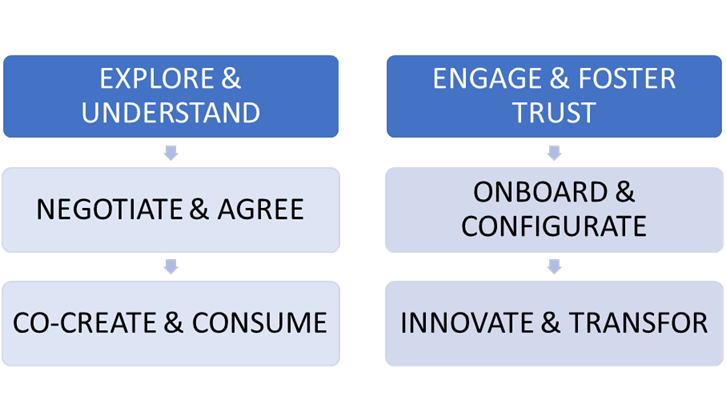
It is crucial to recognize that the service journey is rarely linear. While documented as sequential steps, real-world journeys involve feedback loops, unexpected detours, and parallel pathways. Rather than a strict highway, successful organizations treat the service journey as a series of stepping stones that allow for agility and course correction.
A client might begin their journey at a Basic operational level. However, as trust is established, business needs change, or technology advances, they may loop back to the negotiation phase to transition into a Cooperative or Collaborative model. Conversely, an organization might choose to scale back a highly customized partnership to a standardized utility model to optimize costs.
Summary
Mastering service relationships requires moving beyond transactional thinking. By identifying the distinct needs of sponsors, customers, and users, intentionally choosing the correct relationship archetype (basic, cooperative, or collaborative), and actively managing the fluid paths of the service journey, organizations can design ecosystems that do not just support day-to-day operations, but actively drive strategic growth and innovation.
Sign in or Join the community
Where conversation, connection, and real-world practices come together.

Create an account
Where conversation, connection, and real-world practices come together.
14
Comments (10)
Popular

Dive in
Related
Blog
The New ITIL: Why the Service We Think We Run Is Not Always the Service People Experience
By Scott Everett • Feb 19th, 2026 • Views 126
Blog
How ITIL (Version 5) and AI Are Redefining the Service Desk
By Dr. Arun Singh • Feb 10th, 2026 • Views 216
Blog
The New ITIL: Why the Service We Think We Run Is Not Always the Service People Experience
By Scott Everett • Feb 19th, 2026 • Views 126
Blog
How ITIL (Version 5) and AI Are Redefining the Service Desk
By Dr. Arun Singh • Feb 10th, 2026 • Views 216