Elevating Digital Governance
# ITIL
How ITIL Bridges Management Systems to Drive Performance in High-Velocity Ecosystems
October 22, 2026
Rauf Aliyev
Elevating Digital Governance:
How ITIL Bridges Management Systems to Drive Performance in High-Velocity Ecosystems
1. Executive Summary
Modern enterprise IT operating environments rarely rely on a single management framework. To balance business agility, security, and strategic oversight, organizations routinely adopt a hybrid set of standards: corporate IT governance (e.g., COBIT, ISO/IEC 38500), information security systems (ISO/IEC 27001), and high-velocity delivery methodologies (Agile, DevOps, CI/CD).
However, operating multiple frameworks without a unifying operational architecture creates organizational friction, control redundancies, and performance bottlenecks. ITIL does not attempt to replace or compete with these specialized frameworks; rather, it serves as the essential operational bridge. By converting strategic governance directives into day-to-day service value streams, the ITIL Value System (VS) enables enterprises to maintain control, mitigate operational risk, and drive sustained performance in high-velocity ecosystems.
2. The High-Velocity Governance Dilemma
Digital transformation has fundamentally changed how value is delivered. Organizations are expected to deploy code rapidly, scale infrastructure dynamically, and respond to market shifts in real time. Yet, operating at high velocity introduces significant operational and compliance exposure if governance is treated as a secondary priority or a gatekeeping mechanism.
Enterprises face a persistent structural disconnect:
- Strategic Governance Frameworks: Define control objectives, risk tolerances, and policy direction—answering WHAT must be governed at the board and executive levels.
- High-Velocity Delivery Teams: Focus on rapid execution, continuous integration, and rapid cycle times—answering HOW FAST technical capabilities can be deployed.
- The Operational Gap: High-level policies often remain disconnected from daily engineering activities. When governance functions operate outside routine service workflows, compliance becomes a manual, retrospective review process that throttles release velocity and creates friction between engineering and governance teams.
To resolve this dilemma, organizations need an operational integration layer that translates high-level governance rules into automated, low-friction daily practices.
THE HIGH-VELOCITY GOVERNANCE GAP |
STRATEGIC GOVERNANCE (COBIT / ISO 38500) ──► High-Level Rules & Policies |
▲ │ [ THE OPERATIONAL GAP ] ▼ |
HIGH-VELOCITY DELIVERY (Agile / DevOps) ──► Rapid Execution & Deployments |
3. De-Siloing Frameworks: ITIL as the Operational Interoperability Layer
ITIL’s primary value in complex enterprise ecosystems lies in its interoperability. ITIL provides the common operational language, service taxonomy, and value-stream architecture necessary to bridge disparate management standards.
Rather than competing with COBIT or ISO standards, ITIL acts as an operational execution environment. For example:
- COBIT / ISO/IEC 38500 establishes the decision-making rights, evaluation criteria, and strategic direction for enterprise IT.
- ISO/IEC 27001 defines the Information Security Management System (ISMS) controls required to protect organizational assets.
- Agile & DevOps provide the techniques for rapid product iteration and pipeline automation.
ITIL absorbs these requirements and operationalizes them within the service lifecycle. It ensures that security controls, risk parameters, and audit requirements are natively embedded into routine service value chain activities (Plan, Improve, Engage, Design & Transition, Obtain/Build, Deliver & Support) rather than imposed as external administrative hurdles.
STRATEGIC GOVERNANCE (COBIT / ISO 38500) | |
Sets Control Objectives & Directives ▼ | |
ITIL VALUE SYSTEM (VS) [ the operational interoperability layer ] | |
Translates Controls ▼ | Enables Velocity ▼ |
SECURITY & COMPLIANCE (ISO/IEC 27001 / Audit) | HIGH-VELOCITY DELIVERY (Agile / DevOps) |
4. Connecting Strategic Intent to Value via the ITIL Value System (VS)
The ITIL Value System (VS) provides the organizational architecture required to align strategic governance directives with practical execution. The VS ensures that demand from any framework or business driver is systematically converted into business value.
Governance within the VS performs three essential functions that interact directly with operational practices:
- Evaluate: Assessing changing business models, regulatory landscapes, and risk profiles in coordination with enterprise risk frameworks.
- Direct: Establishing organizational policies, authorization matrices, and service tolerances.
- Monitor: Tracking operational performance, control effectiveness, and value outcomes through real-time ITSM telemetry.
GOVERNANCE IN THE ITIL VS | |
1. EVALUATE | Assessing enterprise needs, risks, and regulatory demands. |
2. DIRECT | Setting policies, authorization levels, and priorities. |
3. MONITOR | Tracking performance, control execution, and value outcomes. |
When enterprise governance directs that financial transactions must maintain complete traceability, ITIL translates this direction into operational workflows across Change Enablement, Access Management, and Service Configuration Management.
5. Operationalizing Enterprise Controls Through Core ITIL Practices
ITIL practices serve as the practical execution mechanisms of the framework. In high-velocity ecosystems, four core practices bridge high-level governance directives with day-to-day technical operations:
5.1. Change Enablement: Balancing Release Velocity with Risk Governance
Traditional change management frequently relied on centralized, slow-moving Change Advisory Boards (CABs). In high-velocity environments, this legacy model creates significant delivery bottlenecks.
ITIL Change Enablement replaces rigid gatekeeping with a risk-calculated authorization model:
- Standard Changes: Low-risk, highly repeatable deployments are pre-authorized and integrated directly into automated CI/CD pipelines, eliminating manual intervention.
- Normal Changes: Risk assessment is decentralized and tailored based on technical impact, allowing fast-track approvals for routine updates while reserving detailed reviews for high-impact architecture modifications.
- Emergency Changes: Streamlined evaluation paths ensure rapid incident remediation while maintaining post-implementation review integrity.
5.2. Information Security Management: Translating ISO Standards into Operational Workflows
Security frameworks like ISO/IEC 27001 specify what security controls must exist. The ITIL Information Security Management practice operationalizes these controls within daily service requests and operational workflows.
By embedding identity verification, privilege reviews, and vulnerability patching directly into standard ITSM procedures, compliance evidence is generated automatically as a natural byproduct of operational execution.
5.3. Service Configuration Management: Ensuring Architectural Transparency and Auditability
Effective governance requires accurate visibility into technical dependencies and data flows. Service Configuration Management (utilizing an active Configuration Management Database - CMDB) maps relationships between software components, cloud infrastructure, third-party services, and business processes.
This architectural transparency allows technical teams to conduct precise impact analyses before deployments and provides internal auditors with real-time, objective visibility into control boundaries.
5.4. Continual Improvement: Sustaining Governance Maturity in Dynamic Environments
Governance models cannot remain static while technical architectures evolve. The ITIL Continual Improvement Model provides a structured 7-step method to refine governance workflows systematically:
- What is the vision? (Aligning improvement with business strategy)
- Where are we now? (Establishing baseline operational metrics)
- Where do we want to be? (Setting target KPIs and control benchmarks)
- How do we get there? (Designing iterative workflow updates)
- Take action (Executing improvements via agile iterations)
- Did we get there? (Validating telemetry against baseline targets)
- How do we keep the momentum going? (Institutionalizing successful changes)
Enterprise Governance Objective | ITIL Practice Realization |
o Controlled & Traceable Releases o Protection of Digital Assets o Architectural Transparency & Audit o Ongoing Adaptive Compliance | o Risk-Calculated Change Enablement o Information Security Management o Service Configuration Management (CMDB) o Continual Improvement Model |
6. Cross-Framework Interoperability Matrix
The matrix below illustrates how ITIL acts as an operational bridge across primary enterprise frameworks and delivery methodologies:
Framework / Standard | Strategic Objective / Primary Focus | ITIL Interoperability Role (Operational Execution) |
COBIT / ISO/IEC 38500 | Enterprise IT Governance & Strategic Alignment | Translates high-level governance directives into executable Service Value Streams and operational metrics. |
ISO/IEC 27001 | Information Security Management System (ISMS) | Operationalizes security controls, Access Control, and Incident practices. |
Prince2 / Agile / Scrum | Iterative Product Development & Velocity | Connects sprint deliverables to broader Service Design, Transition, Support, and Service Level management. |
DevOps | Automated Infrastructure & Continuous Delivery | Embeds automated Change Enablement, Incident Management, and Release Management into build pipelines. |
ISO/IEC 20000 | IT Service Management Standardization | Serves as the implementation guidance for achieving formal ITSM certification requirements. |
7. Pragmatic Implementation Roadmap for IT Leaders
To successfully leverage ITIL as an operational bridge across enterprise governance frameworks, service management leaders should follow a structured four-phase approach:
Implementation Roadmap Phases
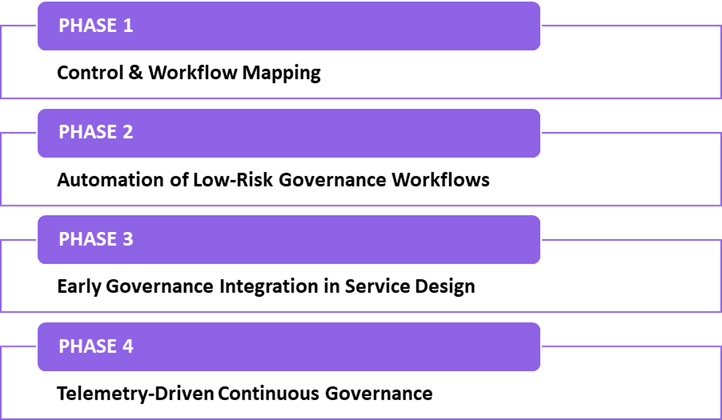
- Phase 1: Control & Workflow Mapping
- Map existing ITIL practice outputs (e.g., change logs, incident records, access requests) directly to control requirements in COBIT, ISO/IEC 27001, or internal audit frameworks.
- Eliminate redundant approval steps that do not contribute to risk mitigation.
- Phase 2: Automation of Low-Risk Governance Workflows
- Integrate ITSM platforms directly into CI/CD pipelines to enable automated logging and pre-authorized Standard Changes.
- Automate compliance evidence collection so that operational metadata is captured naturally without manual engineering effort.
- Phase 3: Early Governance Integration in Service Design
- Involve security, risk, and audit stakeholders during early Service Design and Value Stream mapping activities.
- Define non-functional governance requirements alongside functional software requirements.
- Phase 4: Telemetry-Driven Continuous Governance
- Replace periodic manual compliance audits with real-time ITSM performance dashboards.
- Track key operational metrics such as unapproved change rates, mean time to restore service (MTTR), and security patch compliance.
8. Conclusion
In high-velocity digital ecosystems, governance can no longer operate as an isolated, gatekeeping mechanism. Sustainable organizational performance requires an integrated management system where governance, security, and rapid delivery reinforce one another.
ITIL provides precisely this capability. By serving as a pragmatic operational bridge between strategic governance standards and technical execution, the ITIL Service Value System and its underlying practices enable organizations to maintain control, manage risk, and drive sustained digital performance at scale.
Sign in or Join the community
Where conversation, connection, and real-world practices come together.

Create an account
Where conversation, connection, and real-world practices come together.
1
Comments (0)
Popular

Dive in
Related
Blog
Beyond IT Service Management: ITIL as a Strategic Enabler of Data Governance and Management
By Yurguen Penaranda Th... • Jun 16th, 2026 • Views 58
Blog
What ITIL AI Governance Teaches Us About Maturity in an AI-Enabled World
By Alex Harding • Aug 6th, 2026 • Views 104
Blog
The AI-Native Enterprise: Navigating AI Integration and Governance in ITIL (Version 5)
By Ramesh M • Mar 26th, 2026 • Views 452
Blog
What ITIL AI Governance Teaches Us About Maturity in an AI-Enabled World
By Alex Harding • Aug 6th, 2026 • Views 104
Blog
The AI-Native Enterprise: Navigating AI Integration and Governance in ITIL (Version 5)
By Ramesh M • Mar 26th, 2026 • Views 452
Blog
Beyond IT Service Management: ITIL as a Strategic Enabler of Data Governance and Management
By Yurguen Penaranda Th... • Jun 16th, 2026 • Views 58