The Top 5 Things to Watch in DevOps in 2027
# DevOps
# AI
# Thought Leadership
The next evolution of DevOps – a Delivery System that safely orchestrates software delivery while AI accelerates artifact generation.
September 23, 2026
Debashis Bhattacharyya
The Top 5 Things to Watch in DevOps in 2027
Since its evolution, DevOps has been constantly breaking down barriers between development, operations, security, and product. This validates why organizations have invested heavily in automation, CI/CD, cloud platforms, infrastructure as code, observability, and DevSecOps. As we march towards 2027, I feel the next evolution of DevOps is becoming increasingly clear – a Delivery System that safely orchestrates software delivery while AI accelerates artifact generation.
This is more than another technology cycle. It represents a fundamental change in how engineering organizations design platforms, govern technology, measure productivity, and operate software.
Here are five developments I believe technology leaders and practitioners should watch closely in 2027.
1. Agentic DevOps: From Copilots to Doers
While AI will assist in development activities, agentic DevOps will be key to delivery. Agents will execute steps independently performing tasks like
- Analyze pipeline logs
- Correlate failures with a recent code change
- Identify root cause
- Generate remediation
- Create or update automated tests
- Validate the change
- Submit a pull request
- Trigger the appropriate governance checks
- Recommend or execute a deployment based on predefined policies
The model will extend into infrastructure, security, testing, incident management, and cloud optimization.
This changes the role of the DevOps engineer as automating a process is no longer the ask. The engineer will be increasingly designing, governing, and supervising intelligent automation approving what agents should be allowed to do.
2. Platform Engineering 2.0: The Engineering Control Plane
Platform engineering has emerged as a response to an increasingly evolving technology landscape. Internal Developer Platform hides underlying complexities from Developers and offer them reusable capabilities.
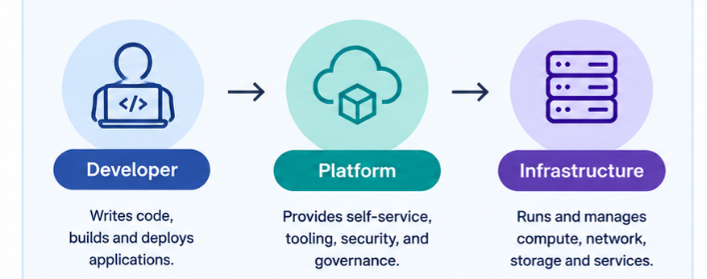
AI introduces a new consumer of these platforms, and they will become highly prevalent in 2027.
Developer + AI Agent → Platform Control Plane → Applications + Infrastructure + Data + AI
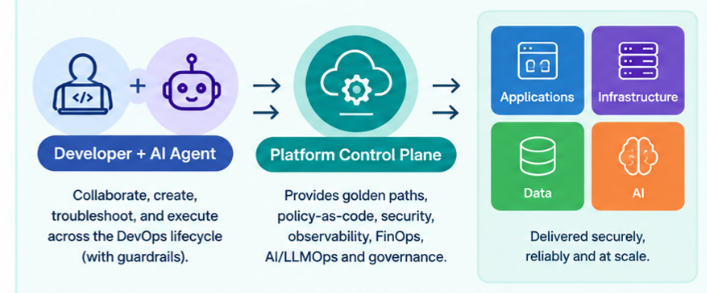
A mature 2027 platform may provide:
- Self-service environments
- Golden paths
- Policy-as-code
- Security controls
- Automated compliance
- Observability
- FinOps
- Infrastructure provisioning
- AI/ML capabilities
- Agent access through APIs and protocols
- Standardized deployment workflows
- Enterprise governance
The platform therefore becomes the control plane for engineering execution.
This also changes the definition of platform engineering success from usage and user metrics to -
- How much cognitive load does the platform remove?
- How safely can developers and agents move from intent to production?
- How effectively does the platform enforce organizational standards without slowing delivery?
3. Autonomous Security and Compliance
Over the past decade, Security has progressively moved left. We moved from security teams reviewing applications after development to integrating security into development and delivery pipelines.
AI changes the equation further beyond detection, wherein the future security lifecycle will need to span to accommodate continuous remediation:
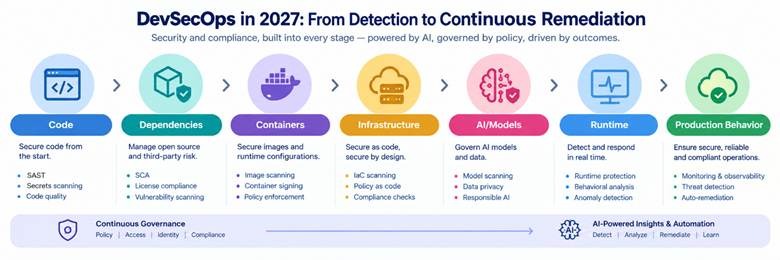
A future DevSecOps workflow will:
- Identify vulnerabilities
- Determine exposure.
- Assess business and runtime impact.
- Identify remediation.
- Generate code or dependency change.
- Generate or update tests.
- Run security and quality validation.
- Create pull request.
- Validate policy requirements.
- Deploy automatically if governance conditions are satisfied.
AI will help reduce security exposure continuously while minimizing the human effort required to remediate it. Organizations will need governance for DevSecOps AI agents -
- Who can create an agent?
- What data can it access?
- What credentials can it use?
- Which environments can it modify?
- Can it deploy to production?
- What approvals are required?
- Can its actions be audited and reversed?
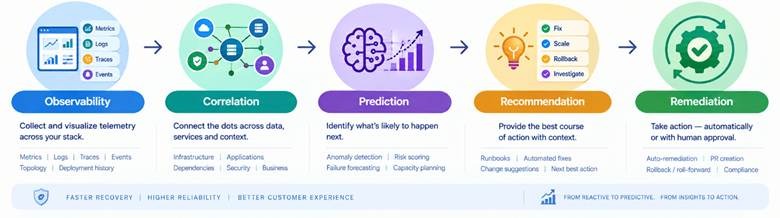
4. Observability - Predictive and Increasingly Autonomous
In 2027, a move from traditional observability will be witnessed that will enable organizations to discuss aspects like “why it happened, when is it likely to happen again, what should be done to avert it”.
This shifts our focus from mere monitoring metrics, logs, and traces to AI-driven operations. Historical incidents, Business transactions, User behavior, security events, topology and deployment history will become key data in building the intelligence that will feed into modern context-aware observability tools.
For example, a sudden latency alert by itself may not mean much. But an intelligent operational platform could understand that latency increased 30 minutes after a deployment, the service depends on a recently changed database, a particular customer transaction is experiencing failures, the infrastructure is approaching a resource threshold, and a similar incident occurred previously. Now this context dramatically changes the quality of the response.
The progression in 2027 could look like:
5. DevOps Economics: From Engineering Productivity to Business Value
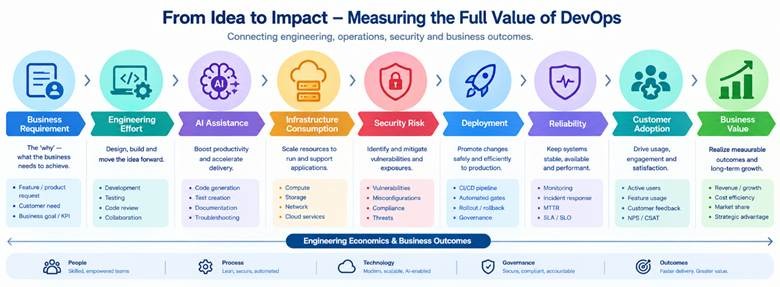
I believe this will be the most significant evolution, and it is not technological but economic. DevOps practitioners will transition from traditional DORA metrics towards business outcomes.
For years, DevOps organizations have measured Deployment frequency, Lead time, Change failure rate, Mean time to restore, Flow efficiency, and developer productivity. These remain valuable. But with AI agents allowing developers to produce artifacts faster, the question will move towards measuring the actual value they deliver. Discussion will also move towards organizational flow and delivery system efficiency. Are we able to validate the AI output at the same rate, or is it an illusion of productivity we are dealing with by measuring existing metrics?
This is why the next generation of DevOps measurement needs to connect engineering activity with business outcomes.
The conversation will increasingly focus on a more holistic definition of engineering productivity.
What Does This Mean for DevOps Professionals?
The evolution toward agentic and autonomous engineering does not eliminate the need for DevOps professionals. It changes the skills required.
The engineer of 2027 and the future will need to understand not only pipelines and infrastructure, but also:
- AI agents – including governance and explainability
- Platform engineering
- Software architecture
- Security
- Cloud economics
- Business outcomes
Perhaps most importantly, engineers will need to become comfortable designing systems where humans and intelligent agents collaborate.
Conclusion
For DevOps, the underlying principle remains unchanged. DevOps is about improving the flow of value from idea to customer. The machinery to achieve the objective is what will be changing. This will be an era where intelligent agents can participate directly in engineering lifecycles. That creates enormous opportunity along with new responsibilities.
The organizations that benefit most will not necessarily be those that deploy the most AI.
They will be the organizations that create the right operating model, platform architecture, governance, security controls, and engineering culture around AI.
And that may be the defining DevOps conversation of 2027:
How do we move from automated software delivery to autonomous engineering, without losing human judgment, trust, security, and accountability?
That is the question worth watching.
Today | 2027 Direction |
CI/CD | Autonomous delivery |
DevOps automation | Agentic DevOps |
Internal Developer Platform | Engineering control plane |
Shift-left security | Continuous security and remediation |
Observability | Predictive operational intelligence |
AIOps | Autonomous SRE |
DORA metrics | Engineering economics |
Human-operated pipelines | Human + AI collaboration |
Sign in or Join the community
Where conversation, connection, and real-world practices come together.

Create an account
Where conversation, connection, and real-world practices come together.
2
Comments (0)
Popular

Dive in
Related
Blog
From Monitoring to Observability: What Modern DevOps Teams Are Missing
By Sunil Agarwal • Jun 18th, 2026 • Views 46
Blog
DevOps Information Overload Is Real, and It’s Quietly Wrecking Good Engineering
By Brian Teller • Jun 24th, 2026 • Views 93
Blog
From Monitoring to Observability: What Modern DevOps Teams Are Missing
By Sunil Agarwal • Jun 18th, 2026 • Views 46
Blog
DevOps Information Overload Is Real, and It’s Quietly Wrecking Good Engineering
By Brian Teller • Jun 24th, 2026 • Views 93